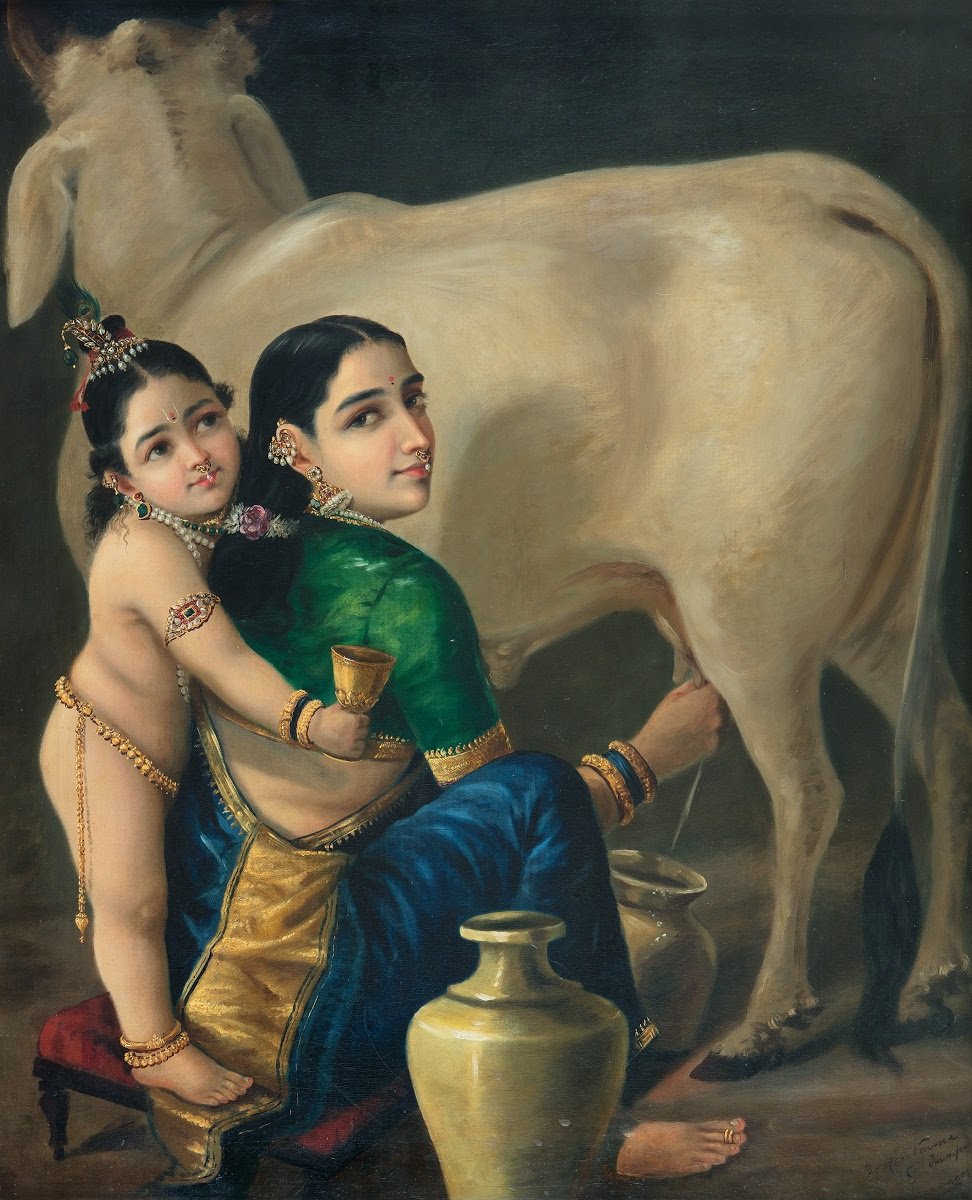
The secondary Indian art auction market has entered an explosive new paradigm, hitting unprecedented heights as rare masterworks command staggering valuations.
In a historic milestone that has sent shockwaves through the global art ecosystem, Raja Ravi Varma’s 1890s masterpiece ‘Yashoda and Krishna‘ sold for an astronomical ₹167.2 crore ($17.9 million) at Saffronart’s live auction. Acquired by billionaire Cyrus Poonawalla—who declared it a “national treasure”—the iconic canvas shattered previous valuation benchmarks. This monumental sale eclipsed the prior international record set by M.F. Husain’s Gram Yatra, which achieved $13.75 million (₹118 crore) at a Christie’s New York auction.
Perspectives from the Gallery Floor
The velocity of this market shift is drawing both celebration and cautious monitoring from India’s elite curators and gallerists:
“We are witnessing a structural revaluation of Indian art on the global stage. Wealthy collectors are no longer just buying decoration; they are fiercely competing for foundational historical assets. Yashoda and Krishna is a museum-grade piece, and the price reflects its absolute rarity.”
— Minal Vazirani, Co-Founder of Saffronart. [1, 2]
“While the top-tier numbers are staggering, the real victory is the depth of the domestic ecosystem. However, this level of capital brings immense pressure. Provenance validation, strict documentation, and technological transparency are now non-negotiable safeguards to defend against sophisticated duplicates entering circulation.”
— Dadiba Pundole, Owner of Pundole’s Auction House. [1, 2]
📈 Top 5 Most Expensive Indian Paintings Ever Sold at Auction
The elite tier of Indian modern art has undergone major changes over the last few seasons, with centuries-old heritage masterpieces challenging the dominance of mid-century modernists. [1]
| Rank | Painting Title | Artist | Price Realised (INR / USD) | Auction House / Year |
|---|---|---|---|---|
| 1 | Yashoda and Krishna | Raja Ravi Varma | ₹167.2 Crore ($17.9M) | Saffronart (2026) |
| 2 | Untitled (Gram Yatra) | M.F. Husain | ₹118 Crore ($13.75M) | Christie’s (2025) |
| 3 | The Story Teller | Amrita Sher-Gil | ₹61.8 Crore ($10.0M) | Saffronart (2023) |
| 4 | Gestation | S.H. Raza | ₹51.75 Crore ($6.27M) | Pundole’s (2023) |
| 5 | Untitled (1971) | V.S. Gaitonde | ₹42 Crore ($7.57M) | Saffronart (2022) |
The 2026 Art Boom: Key Drivers
The extraordinary multi-million dollar bidding wars witnessed across local and global auction houses are not an isolated fluke. Instead, they reflect a deep, structural transformation inside India’s fine art economy:
- Price Over Volume: A comprehensive market evaluation reveals that modern art sales skyrocketed 43.7% year-on-year in the first half of 2026 alone, amassing over ₹1,548 crore. Interestingly, this massive revenue spike is purely price-driven. While the sheer number of available lots grew by a slim 3.21%, the average price per sold lot leaped an incredible 39.23% to ₹74.07 lakh.
- The “New Money” Tsunami: New collectors are stepping into high-end bidding rooms with aggressive intent. Market studies indicate that an astounding 60% to 80% of active buyers in the Indian ecosystem are entirely new to the market. Driven by corporate wealth and a massive multi-generational shift, these fresh collectors view modern and post-war art as premier alternative assets. [1]
- Regulatory Tailwinds: The historic fiscal policy update executed in late 2025—which slashed GST on fine art from 12% down to 5%—significantly mitigated acquisition friction, unleashing massive liquidity into domestic galleries and auction floors.
⚠️ A Double-Edged Sword: The Surge in Sophisticated Fakes
While the skyrocketing valuations of blue-chip Modernists reinforce India’s powerhouse status on the global stage, they have brought a troubling shadow to the surface. [1]
The incredible influx of capital has triggered a worrying surge in highly sophisticated forgeries flooding secondary markets. Because a singular masterwork can instantly command tens of crores, the line between a brilliant genuine piece and an elite fake is getting harder to distinguish.
For modern collectors, premium provenance, impeccable exhibition history, and advanced technical authentication protocols are no longer secondary concerns—they are mandatory guardrails required to participate safely in this high-octane market.